Major Escalations
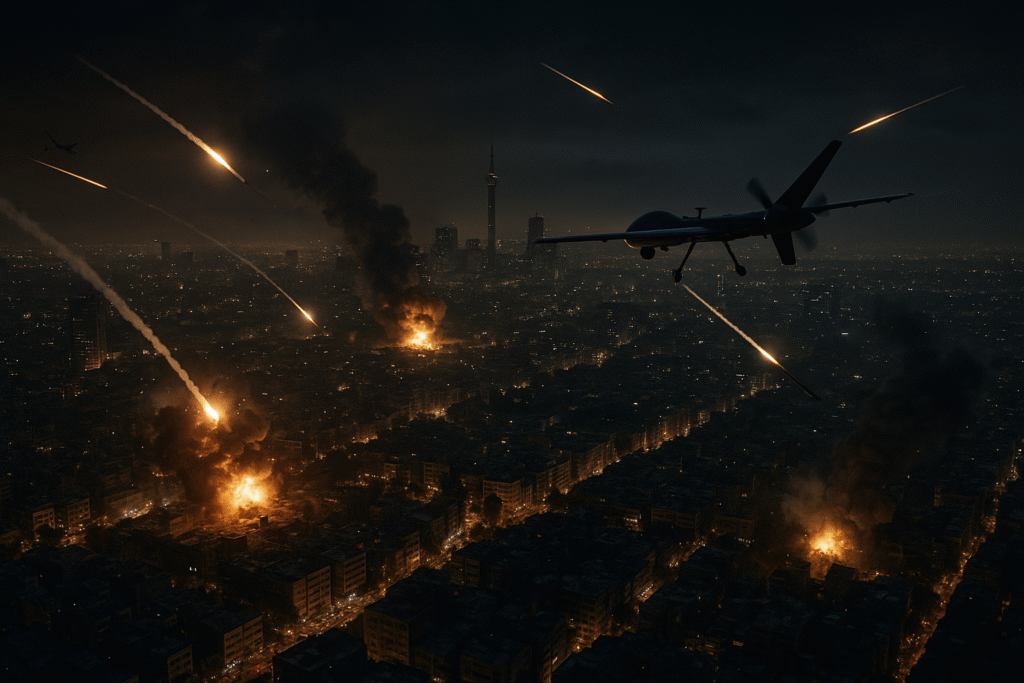
- The war began on June 13, 2025, when Israel launched Operation Rising Lion-tensions between Israel and Iran have escalated into one of the most intense military confrontations in the region in recent years. The operation, described by Israeli officials as a “decisive response” to Iran’s growing nuclear ambitions and regional provocations, targeted a wide range of critical infrastructure across Iran. Strikes reportedly hit nuclear facilities in Natanz and Isfahan, ballistic missile storage sites, drone manufacturing plants, and command centers associated with the Islamic Revolutionary Guard Corps (IRGC). Israel’s intent, according to military analysts, is not only to cripple Iran’s military-industrial capability but to send a direct message to Tehran’s leadership.
- In response, Iran has launched a series of retaliatory missile and drone attacks aimed at southern and central Israel. While Israel’s advanced missile defense systems—including Iron Dome, David’s Sling, and Arrow-3—have intercepted many incoming threats, several Iranian projectiles have made impact, causing damage and civilian casualties. Iranian officials claim their strikes are aimed at military targets, but international observers have reported significant collateral damage. Notably, a missile hit near Soroka Hospital in Be’er Sheva, wounding dozens of civilians and medical staff.
- The conflict has sent shockwaves across the Middle East, raising fears of a broader regional war. Countries like the United States, Russia, and the European Union have urged immediate de-escalation and have offered to mediate. Meanwhile, Iran’s Foreign Minister has demanded an end to Israeli airstrikes as a precondition for any diplomatic talks. With both sides showing little willingness to back down, and internal pressure mounting within both nations, the situation remains highly volatile. Analysts warn that if diplomacy fails, the current standoff could spiral into a prolonged and far more destructive conflict.
Human & Material Toll
- The number of people killed in Iran ranges from at least 224 to 639, including military personnel, scientists, and civilians; the damage includes nuclear, military, energy, healthcare, and water infrastructure. In Israel, there are between 24 and 40 fatalities and hundreds of injuries from missile and drone strikes.
Strategic Aims & Regional Impact
- Israel’s objective: To halt Iran’s nuclear and missile programs—and potentially pressure regime change by targeting symbolic and leadership centers, including statements hinting at Khamenei as a target
- Iran’s stance: Tightly links diplomacy to an immediate ceasefire by Israel; ongoing missile strikes claimed to be directed at military targets though civilian areas have been impacted
Diplomatic Developments
- In order to stop the escalation and pressure for a return to nuclear talks, European diplomats from the UK, France, Germany, and EU are meeting with Iranian FM in Geneva. Iranian Nobel laureate Narges Mohammadi has called for an immediate ceasefire, highlighting the humanitarian toll.
- President Trump (U.S.) is reportedly evaluating options and may decide within two weeks (by early July) whether the U.S. will intervene militarily on Israel’s behalf
- Russia has offered to mediate, proposing a framework that allows peaceful nuclear use in Iran with Israeli security assurances .
Military & Covert Operations
- In order to weaken Iran’s ability to retaliate, Israel’s campaign combines airstrikes, cyberattacks, assassinations, and clandestine Mossad drone sabotage inside Iran that targets missile sites. According to reports, Israeli strikes are causing Iran’s missile stockpile to decrease, which is reducing the frequency of their barrage
What to Watch
- U.S. stance – President Trump’s decision in the coming two weeks could dramatically shift the balance.
- Diplomatic outcomes – Whether Geneva talks, European mediation, or Russia’s offer result in a ceasefire or renewed negotiations.
- Conflict trajectory – Whether targeting leadership like Khamenei becomes open, risking regional spillover.
- Humanitarian effects – Damage to hospitals, critical infrastructure, and Iran’s internal unrest (including internet blackouts and internal displacement, such as mass flight from Tehran)
